SOAP service testing
Review WSDL and SOAP message structure.
Explore the course learning plan Training & Capability DevelopmentLearn. Practise. Apply.⌕
Create test projects for SOAP and REST services and assert expected responses.
Test SOAP and REST services with SoapUI v5.5. Create assertions and mock services, then use Groovy to parameterise checks and integrate routine execution with Jenkins.
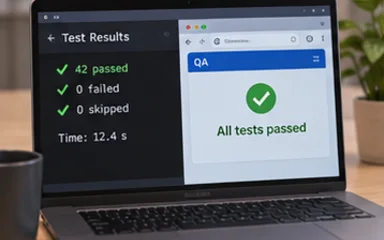
Review WSDL and SOAP message structure.
Explore the course learning planExplore Read service definitions and work with parameters and payloads.
Explore the course learning planReview performance and basic security validation in the lab service workflow.
Explore the course learning planReview WSDL and SOAP message structure. Participants also create requests and assertions and inspect expected responses. The section also examines API Testing, the difference between SOAP & REST API, and SoapUI Tool. Connect each test to an expected behaviour and consider what its result demonstrates, including the limits of the scenario and the setup used.
Explore Read service definitions and work with parameters and payloads. Participants also validate response content and use mock services as lab test dependencies. The section also examines REST APIs, REST API Structure & Parameters, and WADL and swagger definitions. Connect each test to an expected behaviour and consider what its result demonstrates, including the limits of the scenario and the setup used.
Use Groovy to parameterise values and organise repeated test cases. Participants also run scenarios with multiple inputs and review the results. The section also examines Groovy scripting, SoapUI Objects for Interaction, and Programmatically reading test suites, test cases, and test steps. Connect each test to an expected behaviour and consider what its result demonstrates, including the limits of the scenario and the setup used.
Review performance and basic security validation in the lab service workflow. Participants also use Jenkins to run the SoapUI suite and examine its reports. The section also examines Load testing of SOAP & REST APIs, creating a load test for SOAP & REST APIs, and Running & analyzing load test results.
Need the detailed syllabus? Request the course outline.
Check the course fit for your role and experience. Confirm the prerequisites, delivery scope and preparation before booking.
Check the full outline for this course’s tools and technologies. Confirm software versions, licences, accounts, equipment, access and installation requirements before joining.
Ask which preparation materials, follow-up resources or trainer support are included in your selected delivery.
Confirm the certificate, completion requirements and any assessed activities for your selected batch. A practical project does not by itself establish an assessed skills award.
Understand certificates and assessments →Confirm dates, venue, fees, available seats and delivery arrangements with Timmins before booking.
Ask Timmins about upcoming dates for this course.
View the public training calendar →Ask about another date or team delivery. Share your preferred timeframe, city or delivery mode and participant numbers. Timmins will discuss the options; dates, trainer availability, delivery and fees must be confirmed separately. Sending an enquiry does not reserve a place or confirm a class.
Your selected course is included in the draft. Review it and press Send in your messaging app.
API testers, QA engineers and developers responsible for functional testing of web services.
An overview of HTML and XML and Core Java basics for the Groovy exercises.
Check the full outline for this course’s tools and technologies. Confirm software versions, licences, accounts, equipment, access and installation requirements before joining.
The learning plan describes the course topics and activities in the published summary. Ask Timmins to confirm the exercises, trainer feedback and any assessed activities for your selected delivery. Completion and assessed credentials have different requirements.
AI-assisted activities are not listed in this course summary. Ask Timmins to confirm the scope of your selected delivery rather than assuming AI tools are included.
Discuss an in-house programme with Timmins. Share the team’s roles, starting knowledge and workplace challenges. Agree any adaptations, assessment and follow-up support in the proposal.